Last updated: June 2026 · By Ruben Borillo, Sr. WordPress Developer
Disclosure: some links in this article are affiliate links. If you buy through them we may earn a commission at no extra cost to you. We only recommend tools we build with.
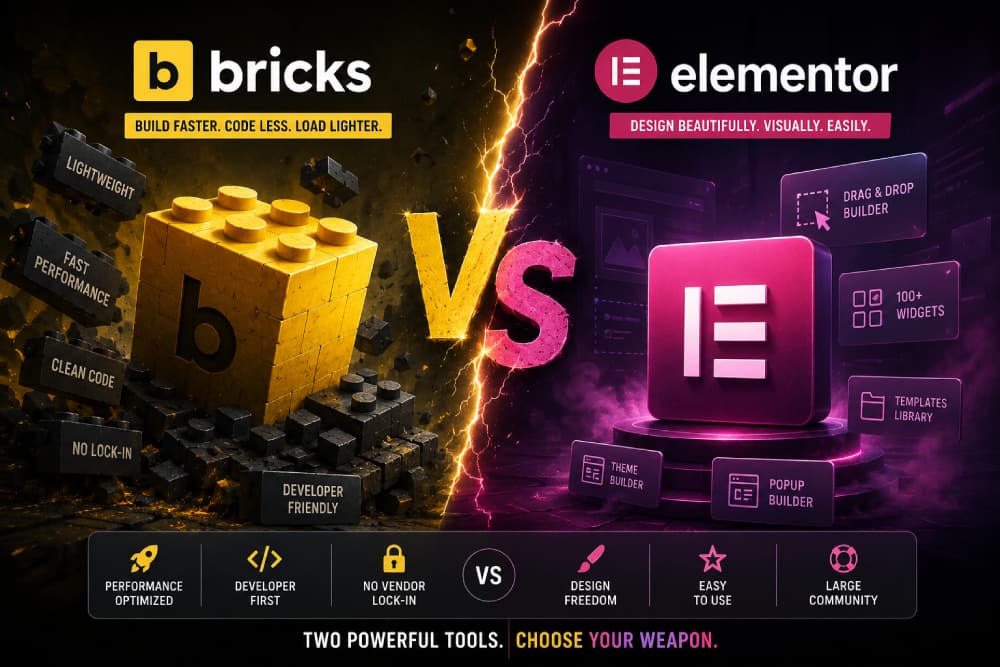
Short answer: Elementor wins on ease of use and ecosystem — it’s the most beginner-friendly builder with the biggest library of templates, add-ons, and tutorials. Bricks wins on performance and developer control — far leaner output, better for fast, custom, hand-built sites. If you’re a beginner or run a content/marketing site, lean Elementor. If you’re a developer or agency that cares about Core Web Vitals, lean Bricks. And if performance is your top priority, there’s a third option most speed-obsessed agencies reach for — more on that below.
Quick comparison table
| Bricks | Elementor | |
|---|---|---|
| Best for | Developers, agencies, performance | Beginners, marketers, fast launches |
| Type | Theme + builder | Plugin (any theme) |
| Performance | Excellent — lean markup | Heavier; improved but more overhead |
| Ease of use | Developer-friendly | Friendliest, most beginner-ready |
| Template/ecosystem | Growing, strong community | Massive — largest of any builder |
| Built-in features | Form builder, global classes | Huge widget set, popups, theme builder |
| Pricing | Annual + lifetime tiers | Free tier + Pro subscription |
| Learning curve | Moderate | Gentle |
| Output cleanliness | Very clean | Improving but more bloat |
Page-builder vendors adjust their tiers periodically, so confirm the latest pricing on each official site before you buy.
Overview: two very different philosophies
Elementor is the world’s most popular WordPress page builder. Its strength is accessibility: a free tier, a gentle learning curve, an enormous template and add-on ecosystem, and a full theme builder in Pro. The trade-off is weight — Elementor adds more markup and scripts, which you have to manage to keep your site fast.
Bricks comes from the opposite direction: a developer-first, performance-first builder (it’s a theme, not just a plugin) that outputs clean code and gives real CSS control via global classes. It’s less “drag a pre-made block,” more “build it right and fast.”
So this isn’t really “which is better” — it’s “which philosophy fits you.”
Performance: which builds faster sites?
This is Bricks’ biggest advantage. Bricks emits lean, close-to-hand-coded markup, so it’s much easier to hit green Core Web Vitals without a pile of optimization plugins. Elementor has genuinely improved its performance in recent versions, but it still carries more overhead by design, and heavy Elementor sites often need caching/optimization work to compete.
If raw speed is your #1 priority, Bricks beats Elementor — and as we’ll see, there’s an even leaner option.
Ease of use: which is friendlier?
Elementor, clearly. If you’re a beginner, a marketer, or you need a non-developer on your team to edit pages, Elementor’s visual, drag-and-drop, what-you-see-is-what-you-get approach is the gentlest on-ramp in the category, backed by endless tutorials.
Bricks is very usable for a developer but assumes more comfort with structure, classes, and WordPress templating. A non-technical editor will be happier in Elementor.
Pricing and licensing
- Elementor: free core plugin + a Pro subscription (annual, tiered by number of sites). Low entry cost, recurring thereafter.
- Bricks: paid up front with annual and lifetime/unlimited tiers — often better long-term value for agencies shipping many sites.
For a single site or a beginner, Elementor’s free tier is unbeatable to start. For an agency doing volume, Bricks’ lifetime/unlimited math usually wins.
Features and ecosystem
Elementor’s ecosystem is its moat: the largest library of templates, third-party add-ons, popups, and a mature theme builder. If you want batteries-included and a marketplace for everything, Elementor leads.
Bricks counters with a native form builder, excellent global classes for maintainable CSS, and a fast-growing, high-quality community — fewer add-ons needed because the core is built for developers.
Migrating from Elementor to Bricks
A frequent 2026 search. There’s no clean one-click migration — moving from Elementor to Bricks is effectively a rebuild, because the two structure pages and styles completely differently. Worth it if you’re chasing performance and maintainability; not worth it just to chase a trend. Plan it as a redesign, not an import.
The third option performance-focused agencies actually use: Oxygen
Here’s the part most “Bricks vs Elementor” posts won’t tell you. If you picked Bricks because of performance, you owe it to yourself to look at Oxygen Builder too. Oxygen is another developer-first builder known for even leaner output, deep low-level control, and a one-time, unlimited-site license — which is often the best cost-per-site math an agency can get. And the old “is Oxygen still maintained?” worry is gone: the Oxygen 6 rebuild put it on a modern engine.
If your priorities are speed + control + cost-per-site (i.e., the reasons you were leaning Bricks over Elementor in the first place), Oxygen belongs on your shortlist.
Want the leanest, most cost-efficient option?
Explore Oxygen Builder → — clean output, unlimited sites, modern Oxygen 6 editor. (See my full Bricks vs Oxygen breakdown for the head-to-head, or migrating an Oxygen site to Bricks if you are moving an existing build.)
Which should you choose?
- Choose Elementor if: you’re a beginner or marketer, you want the easiest editor and the biggest template/add-on ecosystem, and you’re fine managing performance.
- Choose Bricks if: you’re a developer or agency, you want clean output and strong CSS control, and Core Web Vitals matter.
- Look at Oxygen if: performance and cost-per-site are your top priorities — it’s the leanest, most license-efficient of the three. Try Oxygen →
FAQ
Is Bricks better than Elementor?
For performance and developer control, yes — Bricks outputs leaner code and is easier to keep fast. For ease of use and ecosystem, Elementor still leads. The right pick depends on whether you’re a developer or a beginner.
Which is faster, Bricks or Elementor?
Bricks. It emits much leaner markup, so it’s easier to hit green Core Web Vitals without heavy optimization. Elementor has improved but carries more overhead.
Is Elementor good for beginners?
Yes — it’s the most beginner-friendly builder, with a free tier and the largest tutorial and template ecosystem.
Can I migrate from Elementor to Bricks easily?
No one-click path exists; it’s effectively a rebuild because the two structure pages differently. Treat a switch as a redesign.
What’s a faster alternative to both?
Oxygen Builder is known for even leaner output and a one-time unlimited-site license, modernized in the Oxygen 6 rebuild — popular with performance-focused agencies.
Which page builder do you recommend in 2026?
Elementor for beginners and marketers; Bricks for developers and agencies chasing performance; Oxygen if speed and cost-per-site are your top priorities.
Need a WordPress developer?
Let's build something fast, scalable, and SEO-ready — from a custom theme to a full headless stack.
Get in Touch