Disclosure: some links in this article are affiliate links. If you buy through them we may earn a commission at no extra cost to you. We spell out exactly how each product pays us near the end, including the one that pays us far less.
Every agency reaches the same moment. A client’s list crosses a few thousand subscribers, the monthly email invoice lands, and somebody asks why you are renting something you could own.
FluentCRM is one answer. It puts contacts, tagging, campaigns and automation inside WordPress, with no charge per subscriber and no monthly platform fee. ActiveCampaign is the other answer: keep paying every month, and the hard parts stay somebody else’s problem.
Most comparisons stop right there, and that is exactly where agencies get burned. The FluentCRM licence is not the cost of FluentCRM. This guide prices both properly, at four list sizes, including the part almost nobody budgets for.
The quick verdict
Choose FluentCRM if the client’s business already lives in WordPress, the list is above roughly 5,000 people, and somebody on your team will own email deliverability as an ongoing job rather than a one-off setup task.
Choose ActiveCampaign if the list is small, the client is not technical, or a campaign landing in the spam folder would cost you the account. You are buying somebody else’s sending reputation, and at small list sizes that is nearly free.
The uncomfortable middle: under about 2,000 subscribers, self-hosting saves you almost nothing and hands you a new responsibility. The savings only get serious as the list grows.
What you are actually buying
This distinction decides everything else.
ActiveCampaign sells you software and infrastructure: sending servers, IP reputation, bounce processing, feedback loops with the mailbox providers, complaint handling, and a support team whose job includes your delivery rates.
FluentCRM sells you software. Full stop.
That is not a criticism, it is the design. FluentCRM stores contacts, builds segments, runs automations and composes campaigns inside your WordPress database. It does not operate mail servers, and its own team says so plainly — the FluentCRM deliverability documentation recommends a dedicated email service rather than your web host’s built-in mail function. You connect one through an SMTP plugin; FluentSMTP, from the same developers, is free.
So the honest framing is not “one-off versus subscription”. It is: one subscription, or a licence plus a sending service plus your own time.
The hidden cost, priced
Here is the good news, and it is better than most FluentCRM sceptics admit. Raw sending is cheap.
Amazon publishes SES outbound pricing at $0.10 per 1,000 emails on its à la carte option, with plan-based rates from $0.16 per 1,000. A managed dedicated IP adds about $15 a month on top.
At the premium end, Postmark starts at $15 a month for 10,000 emails, with Basic-tier overage at $1.80 per 1,000.
That is the whole “hidden fee” people warn you about. It is real, you must budget for it, and it is still not what makes self-hosting expensive.
The real maths, at four list sizes
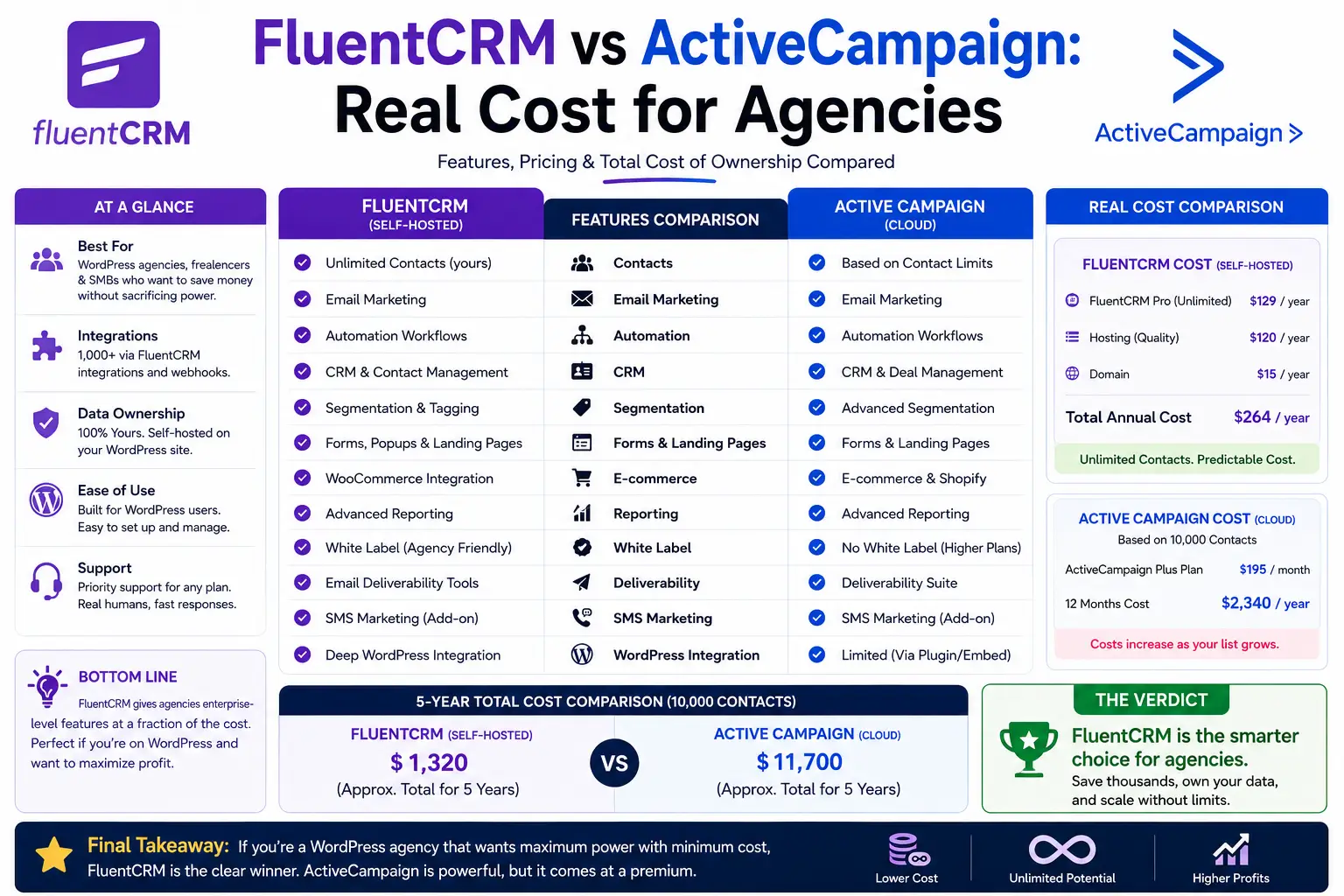
Assumptions: four campaigns a month to the entire list, one FluentCRM single-site licence at its standard renewal price of $129 a year (about $10.75 a month, per FluentCRM’s pricing page), and no dedicated IP.
| List size | Emails / month | FluentCRM licence | Sending via SES | Sending via Postmark | FluentCRM total | ActiveCampaign (indicative) |
|---|---|---|---|---|---|---|
| 1,000 | 4,000 | $10.75 | $0.40 | $15 | $11 – $26 | ~$19 – $99 |
| 5,000 | 20,000 | $10.75 | $2 | $33 | $13 – $44 | ~$99 – $259 |
| 25,000 | 100,000 | $10.75 | $10 | $177 | $21 – $188 | ~$489 – $789 |
| 100,000 | 400,000 | $10.75 | $40 | quote | $51+ | custom quote |
What the table actually says:
- At 1,000 contacts you save maybe $5 to $8 a month. That is not a reason to change anything, and any agency telling a small client to migrate for savings is selling, not advising.
- At 5,000 contacts FluentCRM plus SES runs about $13 a month against roughly $179 for ActiveCampaign’s mid-tier. Across a year that is close to $2,000.
- At 25,000 contacts the annual gap sits somewhere around $5,000, and it keeps widening, because one side charges by the subscriber and the other does not.
One caveat, stated plainly: the ActiveCampaign figures are indicative list prices checked at the time of writing. Their published pricing moves and varies by plan, region and billing term, so run the client’s real contact count through the official ActiveCampaign pricing calculator before you quote anybody.
What you are really paying ActiveCampaign for
Not features. Reputation.
Since February 2024, anyone sending more than 5,000 messages a day to personal Gmail accounts has had to meet published rules. Google’s sender guidelines require SPF and DKIM on the sending domain, a DMARC record, one-click unsubscribe on marketing mail, and spam complaint rates kept below 0.30% — with 0.10% recommended as the level to actually live at.
On ActiveCampaign, nearly all of that is handled, enforced or monitored for you. On FluentCRM the plugin supplies the unsubscribe link and the compliance footer, but the authentication records, the domain warm-up, the complaint monitoring and the judgement call to stop mailing a decaying segment are yours.
That is the real trade. Not money. Responsibility.
The costs that never appear on an invoice
Cron. FluentCRM processes campaigns in scheduled batches. WordPress’s built-in scheduler only fires when somebody loads a page, and the WordPress developer documentation is blunt about it: WP-Cron “does not run continuously, which can be an issue if there are critical tasks that must run on time.” A real system cron calling `wp-cron.php` every minute is not optional once a list has any size to it.
Server headroom. Pushing 100,000 emails a month out of WordPress means sustained background PHP work on the same server that renders the client’s pages. Budget shared hosting will stall, time out mid-campaign, or get you throttled. This is where a chunk of your “saving” goes — into managed cloud hosting with the CPU and RAM to run a queue and a website at once. If you are picking a host for a whole portfolio rather than one site, we compared the options in our guide to managed WordPress hosting for agencies.
Your hours. Somebody configures SPF, DKIM and DMARC. Somebody warms the domain. Somebody watches bounce and complaint rates, prunes dead contacts and works out why one mailbox provider went quiet. At agency rates, a handful of hours a year wipes out the saving on a small list entirely.
Support scope. If a campaign lands in spam on ActiveCampaign, you open a ticket and it becomes their problem. If it happens on FluentCRM, plugin support can correctly tell you the plugin is working as intended — and that is where their responsibility ends.
Where FluentCRM genuinely wins
- The data is already there. WooCommerce orders, LMS progress, membership levels and form submissions are available for segmentation natively, with no sync, no field mapping and no third-party connector to break at 2am.
- Unlimited contacts on every tier. Growth changes your sending bill by cents, not by plan.
- Portfolio economics. The 50-site agency licence at $499 a year works out around 83 cents per site per month. Nothing subscription-based comes close at that spread — and it changes how you price and license plugins for client work.
- Clean handover. The list belongs to the client’s site. No account transfer, no billing hostage situation, no export at renewal time.
- It fits the stack you already ship. For most builds it is one more line on the plugin stack you install on every site.
Where FluentCRM genuinely loses
- Reporting is thinner. Campaign stats are solid; deep attribution and revenue reporting are not in the same league.
- One channel. SMS, WhatsApp and the wider omnichannel tooling are not native. If a client’s plan needs them, this comparison is already over.
- Deliverability is yours forever. Not just at setup. Every month.
- Migration is real work. Lists, tags, automations and their history do not move across cleanly, and rebuilding a mature automation set is a scoped project, not an afternoon.
- It multiplies. Fifty client licences means fifty cron configurations, fifty sending domains and fifty sets of DNS records to keep correct. Cheap per site, not free per site.
Best for X
Best for the WordPress-native business — FluentCRM. A WooCommerce store, a course site or a membership with a growing list is precisely the case the plugin was built for, and the value gets better as the list grows.
Best for the non-technical client with a small list — ActiveCampaign. Under a couple of thousand contacts the cost difference is noise, and outsourced deliverability is worth more than the saving.
Best for a portfolio of client sites — the FluentCRM agency licence, but only if you productise it. Standardise the sending setup, the DNS records and the cron configuration once, then repeat. Improvised per-client email infrastructure is how agencies lose money on this.
Best for agencies that want one platform instead of three — honestly, neither. If the goal is to stop paying for a CRM, an email tool and a funnel builder separately, HighLevel bundles them under one subscription with white-labelling for client accounts. We went through it properly in our GoHighLevel review. At the smaller end of the same idea, systeme.io puts email, funnels, courses and membership on one hosted subscription, which fits a solo client who wants nothing to maintain rather than an agency running many accounts.
Best for high-volume e-commerce — ActiveCampaign. When a deliverability dip costs more per day than the subscription costs per month, stop optimising the subscription.
A word about how each of these pays us
This matters more than the recommendation itself.
ActiveCampaign’s affiliate programme pays a recurring commission — starting at 20% of subscription value and rising to 30%, for up to 12 months per referred customer. WPManageNinja, which makes FluentCRM, pays 20% of the purchase, on a licence costing a fraction of one year of ActiveCampaign.
In plain terms: recommending ActiveCampaign pays us several times more, and keeps paying. We are telling you this because the maths above points the other way for most agencies, and you deserve to check our incentives against our conclusion.
Final recommendation
Stop treating this as a pricing decision and treat it as a staffing one.
If your agency has somebody who will own deliverability — check the authentication records, watch complaint rates, keep the cron honest, prune the list — FluentCRM is the better commercial answer above roughly 5,000 contacts, and the gap becomes hard to argue with above 25,000. The sending fee is genuinely small; the ownership is the price.
If nobody will own that, ActiveCampaign is not the expensive option. It is the correctly priced one, and pretending otherwise means billing a client for infrastructure you are not maintaining.
Whichever way you go, decide before the migration, not after the first campaign lands in the promotions tab. And if you are still assembling the rest of the stack around it, start with our rundown of essential WordPress tools for freelance designers and the all-in-one tools for running a digital agency.
Frequently Asked Questions
Does FluentCRM send emails on its own?
No. FluentCRM stores contacts and builds campaigns inside WordPress, but it does not run mail servers. You connect a sending service such as Amazon SES, Postmark, Mailgun or Brevo through an SMTP plugin. FluentCRM’s own documentation recommends a dedicated email service rather than your web host’s built-in mail function, and its free FluentSMTP plugin handles the connection.
Is FluentCRM actually cheaper than ActiveCampaign?
It depends on list size. At around 1,000 contacts the difference is roughly $5 to $8 a month, which is not worth migrating for. At 5,000 contacts the gap is close to $2,000 a year, and at 25,000 contacts it is in the region of $5,000 a year. FluentCRM’s licence does not scale with subscribers, so the saving grows with the list.
How much does it cost to send 100,000 emails a month from WordPress?
Using Amazon SES at its published à la carte rate of $0.10 per 1,000 emails, 100,000 sends cost about $10 a month. Add a FluentCRM single-site licence at roughly $10.75 a month and the total is around $21. A premium provider such as Postmark would push the same volume closer to $180 a month, and a managed dedicated IP adds about $15.
Will my email deliverability get worse if I move to FluentCRM?
Not automatically, but it becomes your responsibility. A reputable sending service handles the IP reputation; you handle SPF, DKIM and DMARC records, domain warm-up, bounce and complaint monitoring, and list hygiene. Google requires senders of more than 5,000 daily messages to Gmail accounts to meet those authentication rules and keep spam complaints below 0.30%. If nobody on the team will own that ongoing work, a managed platform is the safer choice.
Can one FluentCRM licence cover multiple client sites?
Yes. Licensing is by number of sites, not subscribers. The single-site tier is $129 a year, the five-site tier $249, and the 50-site agency tier $499 — about 83 cents per site per month at the top tier. Each site still needs its own sending configuration, DNS records and cron setup, so budget the setup time separately from the licence.
Does FluentCRM work on shared hosting?
For small lists, usually. For real volume, no. Sending campaigns in batches means sustained background PHP work on the same server that serves the website, and budget shared plans typically throttle it or time out mid-campaign. WordPress’s built-in scheduler also only runs when a page is loaded, so a proper system cron running every minute is required for reliable batch processing.
Which is better for WooCommerce stores?
FluentCRM has the advantage on data, since order history, products purchased and customer values are in the same database and available for segmentation with no sync or connector. ActiveCampaign has the advantage on scale and reporting, with deeper revenue attribution and predictive features. For a growing store with an in-house or agency technical owner, FluentCRM usually wins on cost; for high-volume stores where an inbox placement problem costs real revenue daily, ActiveCampaign is the safer buy.
Run your client’s real contact count through both cost models before you commit. If the list is under 2,000, stay on ActiveCampaign and revisit at 5,000. If it is already past 25,000, price a FluentCRM migration properly — licence, sending service, hosting headroom and the hours to own deliverability — and quote it as a project, not a saving.
Need a WordPress developer?
Let's build something fast, scalable, and SEO-ready — from a custom theme to a full headless stack.
Get in Touch