If you build one website a year, any SEO plugin will do the job. If you look after twenty client sites, the choice turns into something else: a bill you pay every year, a support ticket waiting to happen, and an awkward conversation the day a client leaves.
So this is not another feature list. This is the best SEO plugin for agencies question answered the way an agency actually has to answer it. What does the licence cost at 10, 25 and 50 sites? Can you put your own name on it? How fast can you fix 400 meta descriptions? And what breaks when the client stops paying?
Prices were checked in August 2026. Every figure excludes VAT and is shown in the currency each vendor publishes.
Disclosure: some links in this article are affiliate links. If you buy through them we may earn a commission at no extra cost to you. It does not change what we recommend.
Quick verdict
Short on time? Here is the whole article in five lines.
- Best for most agencies: SEOPress PRO. One unlimited-site licence at $149 a year, plus real white labelling that strips the plugin’s branding out of the client’s dashboard.
- Best for client reporting: Rank Math Business. €299.88 a year covers 100 client sites and adds a client dashboard and white-labelled email reports.
- Best when the client asked for it by name: Yoast SEO Premium. It is the brand non-technical clients recognise, and it is the only one of the three billed as one clean subscription per site.
- Worst value at scale: Yoast, unless you can buy a large batch of licences in a single order.
- Cheapest honest answer: the free versions. All three free plugins handle titles, meta, sitemaps, schema and basic redirects well enough for a small brochure site.
The three plugins at a glance
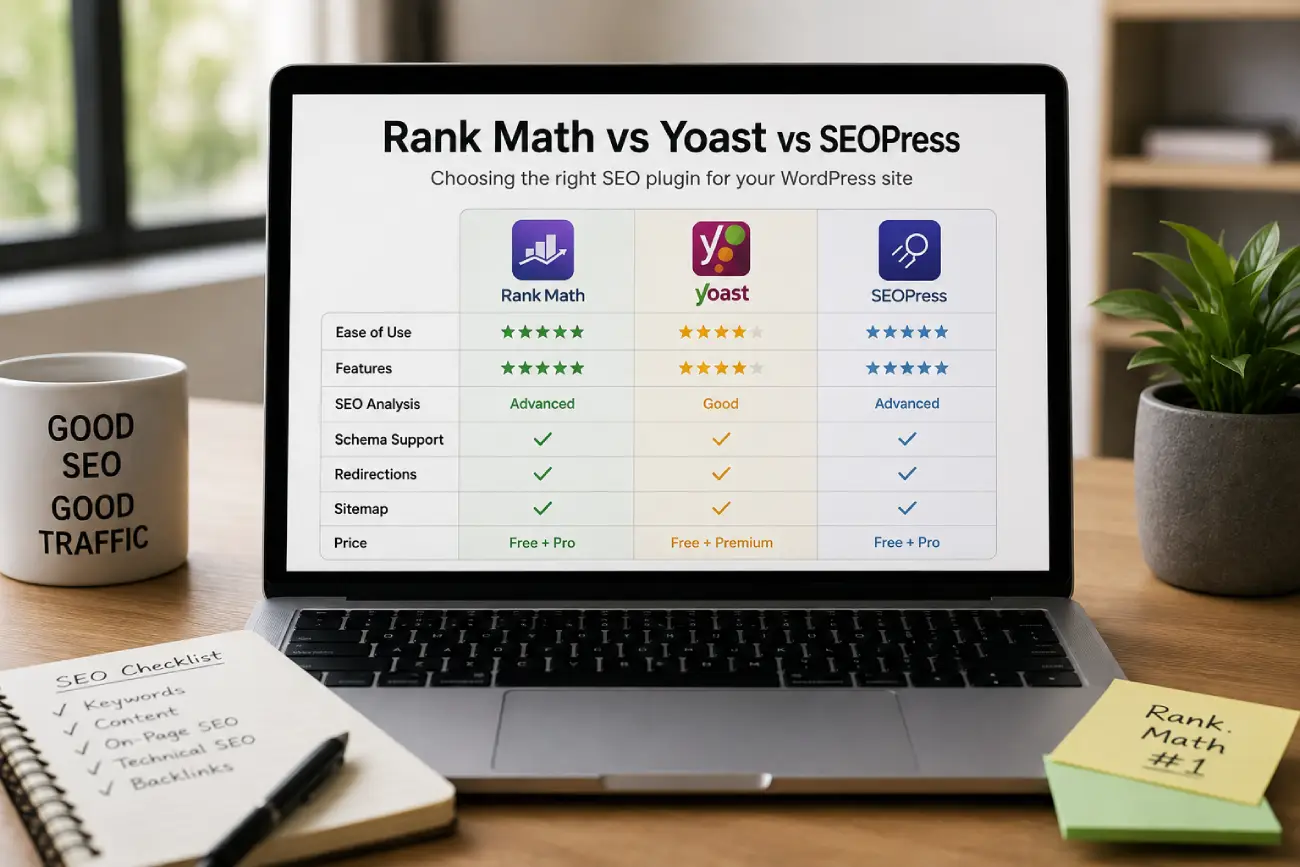
| Rank Math | Yoast SEO | SEOPress | |
|---|---|---|---|
| Entry paid price | €95.88/yr (PRO) | $118.80/yr | $49/yr |
| What that covers | Unlimited personal sites | One site | One site |
| Agency licence | €299.88/yr, 100 client sites | Per site, bulk discounts | $149/yr, unlimited sites |
| Larger tier | €659.88/yr, 500 client sites | Custom pricing at 100+ | None needed |
| White label the plugin | No | No | Yes |
| White-labelled reports | Yes (Business and Agency) | No | Via your own reporting stack |
| Central multi-site dashboard | Yes, built in | No | Via MainWP integration |
| Bulk metadata editing | Yes, in the posts list | Yes, dedicated bulk editor | WP-CLI and REST API |
| Site tied to | Your Rank Math account | A per-site subscription | A licence key |
What a licence really costs at 10, 25 and 50 sites
This is the part most comparison posts skip, and it is the only part your accountant cares about.
Yoast SEO Premium
Yoast sells one subscription per site at $118.80 a year. There is no unlimited tier. What there is instead is a volume discount that starts at five subscriptions and climbs in steps, reaching 20% at 25 subscriptions and 35% at 50, with custom pricing above 100. You can see the full ladder on the Yoast volume discount page.
There is a catch buried in that page, and it matters more than the percentages. The discount only applies when the subscriptions are bought in the same order, for the same product. Agencies almost never buy that way. You onboard one client in March, two in June, one more in September. Bought one at a time, every one of those sites costs full price.
Best case, buying in a single batch:
- 10 sites at 15% off: $1,009.80 a year, or about $101 per site
- 25 sites at 20% off: $2,376 a year, or about $95 per site
- 50 sites at 35% off: $3,861 a year, or about $77 per site
Rank Math
Rank Math splits its plans by who owns the website, not by how many you have. PRO is €95.88 a year for unlimited personal sites. Business is €299.88 a year and covers 100 client sites. Agency is €659.88 a year for 500.
- 10 client sites on Business: about €30 per site
- 25 client sites on Business: about €12 per site
- 50 client sites on Business: about €6 per site
Rank Math also sells a bundle of PRO with WP Rocket at €143.88 a year. Read the small print before you get excited: that bundle sits on the personal-site tier and the caching licence covers a single website, so it is a solo-operator deal rather than an agency one.
SEOPress PRO
SEOPress is the simplest of the three. According to the SEOPress pricing page, PRO is $49 a year for one site, $59 for five, and $149 a year for unlimited sites. The company also states that plans renew at the same price rather than jumping after year one.
- 10 sites: about $15 per site
- 25 sites: about $6 per site
- 50 sites: about $3 per site
At fifty sites you are looking at roughly $3,861 a year for Yoast, about €300 for Rank Math Business, and $149 for SEOPress. That is not a rounding difference. That is the cost of a decent laptop every year, and it is the single strongest argument for moving a portfolio off per-site licensing. If you are still working out how to pass tool costs on to clients, our guide to pricing and licensing WordPress themes and plugins covers the retainer maths.
The licensing trap most agencies walk into
Here is the mistake we see constantly. An agency buys Rank Math PRO, sees “unlimited websites” and installs it on thirty client builds.
That is not what the licence says. Rank Math draws a hard line between a personal site, which you own outright, and a client site, which you do not. Their own documentation on choosing between the PRO, Business and Agency plans states plainly that you cannot use Rank Math PRO on your client websites. Client work needs Business or Agency.
It is worth reading a licence properly before you standardise on a plugin across a whole portfolio. The wrong reading is the kind of thing that surfaces in an audit rather than in a support ticket.
White labelling: what each one actually offers
“White label” gets used loosely, so let us split it into two different things.
Rebranding the plugin itself means the client logs in and sees your agency’s name where the vendor’s name used to be. Only SEOPress does this. Its agency page describes removing all references to SEOPress and swapping the logo, labels, icons and menus for your own. That is the real thing, and it is included rather than sold as an add-on. You can see the full agency toolkit on the SEOPress developers and agencies page.
Rank Math has said publicly that it does not offer a white-label version of the plugin, and Yoast does not either. Both leave their branding in the client’s admin.
White-labelled reporting is the second, smaller thing: the monthly email that lands in the client’s inbox with your logo on it. Rank Math covers this on the Business and Agency plans through its white-label SEO report feature. With Yoast or SEOPress you would build that layer yourself, usually in whatever reporting tool you already use.
Whether any of this matters depends on your positioning. If you resell under your own brand end to end, the same logic that pushes agencies towards white-label and reseller hosting applies to the plugin sitting in the client’s dashboard.
Bulk editing and managing sites at scale
Three sites is a workflow. Thirty is an operations problem.
Yoast has the friendliest bulk tool. Its bulk editor gives you a two-tab screen of every post’s SEO title and meta description, editable in place. If your job today is rewriting 300 meta descriptions after a rebrand, this is the fastest of the three to teach a junior.
Rank Math puts SEO title, description and details straight into the WordPress posts list once bulk editing is switched on, so you edit metadata without opening a single post. Its Business and Agency plans add a client management dashboard that lists every connected site in one place, which is the closest thing any of the three has to a real agency console.
SEOPress takes the developer route. It exposes SEO metadata through WP-CLI and a REST API, imports and exports global settings as a JSON file so a new build can inherit your house configuration in seconds, and connects to MainWP if you want one dashboard across a portfolio. Less clicking, more scripting. If your team already automates deployments, it is the most powerful of the three. If it does not, it is the most awkward.
Client handover: whose account is this site tied to?
Every agency eventually hands a site back. How painful that is depends on how the licence is attached.
Yoast is the cleanest. One subscription equals one site, so it maps one-to-one onto one client and can be billed as a straight pass-through cost. When the relationship ends, that site’s licence is a separate object you are not untangling from anything else.
Rank Math connects each site to a Rank Math account, and that account is usually yours. Handover means disconnecting the site from your account inside the WordPress dashboard and having the client connect their own, as described in the connect and disconnect guide. Not difficult, but it is a step people forget, and a forgotten site keeps burning a slot in your 100-site allowance.
SEOPress unlimited is the messiest on paper. The licence is yours, not the client’s, so when the site leaves your portfolio it either needs its own $49 licence or it drops back to the free version. In practice that is often fine, because SEOPress Free is unusually complete. But it is a conversation to have before the handover meeting, not during it.
Whatever you use, add “transfer or cancel the SEO licence” to your offboarding checklist. It takes two minutes on the day and saves an hour six months later.
What happens when the client stops paying
This is the scenario nobody plans for and everybody meets.
The good news first, and it applies to all three: your SEO titles, meta descriptions and schema settings are stored in the site’s own database, not in the vendor’s cloud. A lapsed licence does not wipe the work. Rankings do not fall off a cliff on renewal day.
Yoast is the most explicit about it. Yoast’s own documentation on whether a licensed plugin expires says the plugin keeps working after a subscription ends, with the exception of the morphology (word form) features and the AI features, which need an active subscription. What you lose is updates and support, and that is the real risk: an unmaintained plugin on a site running current WordPress is a security problem waiting for a date.
Rank Math keeps the plugin installed when a subscription lapses, but PRO functionality is tied to an active, connected licence, and updates stop.
SEOPress behaves the way most WordPress licences do: the site keeps running, and updates and support stop.
The practical rule is the same in all three cases. An expired SEO plugin is not an emergency this week. It is an emergency in eight months. Put licence renewal dates in the same calendar as your care-plan renewals, and if a client cancels, downgrade them deliberately to the free version rather than leaving a stale premium build on the server.
Best for X: the call for each situation
You run 10 or more client sites and you want the lowest total cost. SEOPress PRO unlimited. Nothing else is close on price, and the white labelling is a genuine differentiator when you resell under your own brand. Mark it up on the retainer if you want.
You want one dashboard and monthly reports with your logo on them. Rank Math Business. The client management console and white-labelled email reports do work you would otherwise pay a reporting tool for, and at 25 sites you are still around €12 per site per year.
The client is enterprise, or their marketing team already knows Yoast. Yoast SEO Premium. You are buying familiarity and a clean per-site subscription that survives handover without any account gymnastics. Budget for it properly, because at scale it is expensive.
You mostly build small brochure sites. Use the free version of any of the three. Titles, meta, XML sitemaps, schema and basic redirects are covered at no cost, and you can upgrade the one site that grows into needing more.
You run a custom or headless build. Look hard at SEOPress. The REST API and WP-CLI support make it the easiest of the three to drive from outside the WordPress admin.
Where each one honestly falls short
No plugin here is perfect, and pretending otherwise helps nobody.
Rank Math has the busiest settings screen of the three. There are a lot of toggles, and handing that dashboard to a client who wanted to change one page title is a support ticket in the making. Its site limits also mean you have to keep the client list tidy or you pay for slots you stopped using.
Yoast is the most polished and, for agency work, the hardest to justify. The per-site model punishes exactly the customer profile that uses it most. The bulk discount ladder helps only if you buy in batches, which is not how client work arrives.
SEOPress has the smallest ecosystem and the thinnest pile of third-party tutorials. When something odd happens at 11pm, there are fewer forum threads to search. It is also the most developer-shaped of the three, which is a strength for a technical team and a liability for a team of designers.
And one thing none of them do: make your site fast. An SEO plugin will not fix a failing Core Web Vitals score. That belongs to your hosting and your caching layer, which is a separate decision covered in our comparison of WP Rocket against the free caching plugins.
Plugin choice also has to survive your theme structure. If you build on a code-first builder, the Oxygen Builder SEO guide for agencies walks through what changes on that stack.
Switching without losing rankings
If this comparison has convinced you to move, do not just deactivate one plugin and activate another. All three ship importers that pull titles, meta descriptions and settings across from the others, and SEOPress can import global settings from a JSON file so a whole portfolio inherits the same configuration.
Run the import on a staging copy first, spot-check twenty pages against the live site, and confirm your redirects survived the move. The same discipline applies here as in any migration, and our checklist for migrating WordPress without losing SEO covers the steps that are easy to forget.
Final recommendation
For an agency running ten or more client sites in 2026, SEOPress PRO unlimited is the rational default. The maths is not close, the white labelling is real, and the renewal price does not move.
Rank Math Business is the better buy if reporting and a central dashboard are part of what you sell. At around €12 per site per year at 25 sites, it is still far cheaper than per-site licensing, and you get the agency console with it.
Yoast SEO Premium is a client-request purchase, not a portfolio purchase. When a client insists on it, charge it through and move on.
And if you are still assembling the rest of the stack around whichever one you pick, our roundup of the plugins every freelance designer should be using covers what pairs well with each.
Frequently Asked Questions
Which SEO plugin is cheapest for an agency with 25 client sites?
SEOPress PRO. Its unlimited-site licence is $149 a year no matter how many sites you run, which works out at roughly $6 per site at 25 sites. Rank Math Business is next at €299.88 a year for up to 100 client sites, about €12 per site. Yoast SEO Premium is the most expensive by a wide margin, because it is billed per site at $118.80 a year with volume discounts that only apply when licences are bought in one order. Prices checked August 2026, excluding VAT.
Can I use Rank Math PRO on my client websites?
No. Rank Math’s documentation states that the PRO plan covers personal websites you own outright, not client sites. Work on a website owned by someone else needs the Business plan, which covers 100 client sites, or the Agency plan, which covers 500. This is the most common licensing mistake agencies make with Rank Math.
Which WordPress SEO plugin can be white labelled?
SEOPress is the only one of the three that lets you rebrand the plugin itself, removing its references and replacing the logo, labels, icons and menus with your own. Rank Math does not offer a white-label version of the plugin, though its Business and Agency plans include white-labelled email reports. Yoast does not offer white labelling.
What happens to my SEO data if the licence expires?
Your titles, meta descriptions and schema settings are stored in the WordPress database, so they stay in place and your rankings do not change on renewal day. What stops is updates and support. Yoast states that the plugin keeps working apart from its morphology and AI features. Rank Math keeps the plugin installed but ties PRO functionality to an active, connected licence. The real risk with all three is running an unmaintained plugin for months, which becomes a security problem.
How do I hand an SEO plugin licence over to a client?
It depends on the licence model. Yoast is one subscription per site, so it maps to a single client as a clean line item. Rank Math sites are connected to your Rank Math account, so you disconnect the site from the WordPress dashboard and the client connects their own licence. A SEOPress unlimited licence belongs to you and cannot follow the site, so the client either buys their own single-site licence or the site falls back to SEOPress Free.
Is the free version of any of these enough for a small client site?
Usually, yes. All three free versions handle SEO titles, meta descriptions, XML sitemaps, schema markup and basic redirect or breadcrumb needs, which covers most small brochure sites. Upgrade when a specific site needs the extras: multi-keyword optimisation, advanced schema, richer redirect management or, for agencies, the licensing and white-label terms that only come with a paid plan.
Will switching SEO plugins hurt my rankings?
Not if you migrate the data rather than starting over. All three include importers that pull titles, meta descriptions and settings across from the others. Run the import on a staging copy first, spot-check around twenty pages against the live site, and confirm your redirects came across before you switch anything on the live site.
Pick the licence that matches how you actually work, not the one with the biggest feature list. Price it into your retainer, put the renewal date in the same calendar as your care plans, and standardise every new build on the same plugin so your team only has to learn one dashboard. Not sure which way to go? Start with the free version on your next project and upgrade the one site that outgrows it.
{ “@context”: “https://schema.org”, “@graph”: [ { “@type”: “BlogPosting”, “headline”: “Rank Math vs Yoast vs SEOPress: Best SEO Plugin for Agencies”, “description”: “Rank Math, Yoast and SEOPress compared for agencies: real cost at 10, 25 and 50 client sites, white-label limits, bulk editing and handover.”, “author”: { “@type”: “Organization”, “name”: “Build With Rab”, “url”: “https://buildwithrab.com/blog/” }, “publisher”: { “@type”: “Organization”, “name”: “Build With Rab”, “url”: “https://buildwithrab.com/blog/” }, “datePublished”: “2026-08-09”, “dateModified”: “2026-08-09”, “image”: “https://cms.buildwithrab.com/wp-content/uploads/wordpress-seo-plugin-comparison-agency.webp”, “mainEntityOfPage”: { “@type”: “WebPage”, “@id”: “https://buildwithrab.com/blog/blog/rank-math-vs-yoast-vs-seopress-agencies” }, “about”: [ { “@type”: “SoftwareApplication”, “name”: “Rank Math” }, { “@type”: “SoftwareApplication”, “name”: “Yoast SEO” }, { “@type”: “SoftwareApplication”, “name”: “SEOPress” } ] }, { “@type”: “FAQPage”, “mainEntity”: [ { “@type”: “Question”, “name”: “Which SEO plugin is cheapest for an agency with 25 client sites?”, “acceptedAnswer”: { “@type”: “Answer”, “text”: “SEOPress PRO. Its unlimited-site licence is $149 a year no matter how many sites you run, which works out at roughly $6 per site at 25 sites. Rank Math Business is next at €299.88 a year for up to 100 client sites, about €12 per site. Yoast SEO Premium is the most expensive by a wide margin, because it is billed per site at $118.80 a year with volume discounts that only apply when licences are bought in one order. Prices checked August 2026, excluding VAT.” } }, { “@type”: “Question”, “name”: “Can I use Rank Math PRO on my client websites?”, “acceptedAnswer”: { “@type”: “Answer”, “text”: “No. Rank Math’s documentation states that the PRO plan covers personal websites you own outright, not client sites. Work on a website owned by someone else needs the Business plan, which covers 100 client sites, or the Agency plan, which covers 500. This is the most common licensing mistake agencies make with Rank Math.” } }, { “@type”: “Question”, “name”: “Which WordPress SEO plugin can be white labelled?”, “acceptedAnswer”: { “@type”: “Answer”, “text”: “SEOPress is the only one of the three that lets you rebrand the plugin itself, removing its references and replacing the logo, labels, icons and menus with your own. Rank Math does not offer a white-label version of the plugin, though its Business and Agency plans include white-labelled email reports. Yoast does not offer white labelling.” } }, { “@type”: “Question”, “name”: “What happens to my SEO data if the licence expires?”, “acceptedAnswer”: { “@type”: “Answer”, “text”: “Your titles, meta descriptions and schema settings are stored in the WordPress database, so they stay in place and your rankings do not change on renewal day. What stops is updates and support. Yoast states that the plugin keeps working apart from its morphology and AI features. Rank Math keeps the plugin installed but ties PRO functionality to an active, connected licence. The real risk with all three is running an unmaintained plugin for months, which becomes a security problem.” } }, { “@type”: “Question”, “name”: “How do I hand an SEO plugin licence over to a client?”, “acceptedAnswer”: { “@type”: “Answer”, “text”: “It depends on the licence model. Yoast is one subscription per site, so it maps to a single client as a clean line item. Rank Math sites are connected to your Rank Math account, so you disconnect the site from the WordPress dashboard and the client connects their own licence. A SEOPress unlimited licence belongs to you and cannot follow the site, so the client either buys their own single-site licence or the site falls back to SEOPress Free.” } }, { “@type”: “Question”, “name”: “Is the free version of any of these enough for a small client site?”, “acceptedAnswer”: { “@type”: “Answer”, “text”: “Usually, yes. All three free versions handle SEO titles, meta descriptions, XML sitemaps, schema markup and basic redirect or breadcrumb needs, which covers most small brochure sites. Upgrade when a specific site needs the extras: multi-keyword optimisation, advanced schema, richer redirect management or, for agencies, the licensing and white-label terms that only come with a paid plan.” } }, { “@type”: “Question”, “name”: “Will switching SEO plugins hurt my rankings?”, “acceptedAnswer”: { “@type”: “Answer”, “text”: “Not if you migrate the data rather than starting over. All three include importers that pull titles, meta descriptions and settings across from the others. Run the import on a staging copy first, spot-check around twenty pages against the live site, and confirm your redirects came across before you switch anything on the live site.” } } ] }, { “@type”: “BreadcrumbList”, “itemListElement”: [ { “@type”: “ListItem”, “position”: 1, “name”: “Home”, “item”: “https://buildwithrab.com/blog/” }, { “@type”: “ListItem”, “position”: 2, “name”: “Blog”, “item”: “https://buildwithrab.com/blog/blog” }, { “@type”: “ListItem”, “position”: 3, “name”: “Rank Math vs Yoast vs SEOPress: Best SEO Plugin for Agencies”, “item”: “https://buildwithrab.com/blog/blog/rank-math-vs-yoast-vs-seopress-agencies” } ] } ] }Need a WordPress developer?
Let's build something fast, scalable, and SEO-ready — from a custom theme to a full headless stack.
Get in Touch